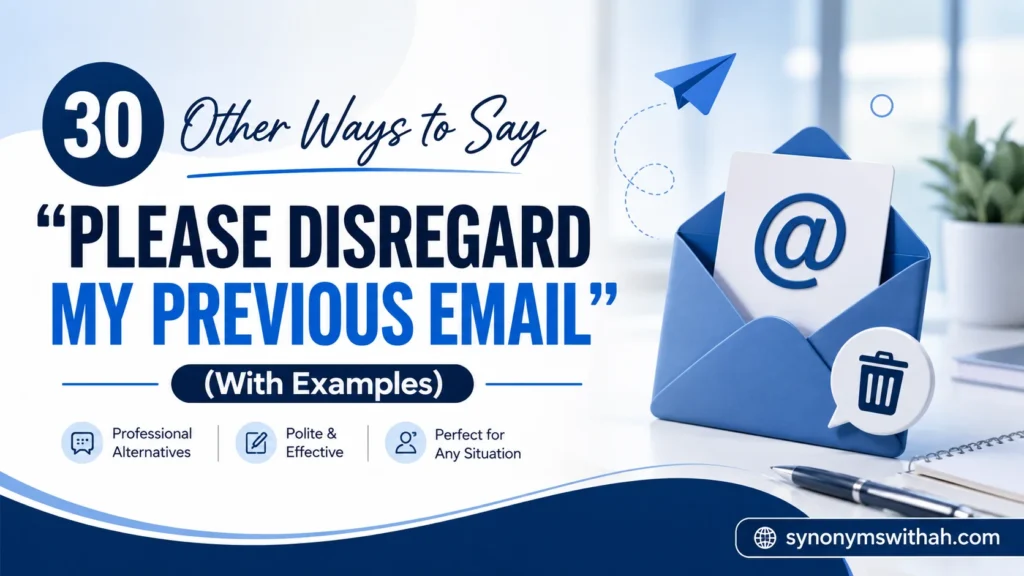

30 Other Ways to Say “Please Disregard My Previous Email” (With Examples) helps you fix mistakes politely while keeping trust and professionalism strong.
A wrong email can happen to anyone, and I have learned that a quick follow-up, follow-up email, or follow-up message protects your professional reputation, reputation, and rapport with the recipient. Whether the original email was prematurely sent, prematurely shared, included mistakes, a mistake, incorrect information, a typo, or a blunder, the best approach is to acknowledge the issue with honesty, sincerity, respect, courtesy, and confidence. A simple message, notification, or response with clear communication can clarify the problem, minimize confusion, reduce fallout, and rebuild trust while maintaining relationships. Even if Gmail offers an undo or undo option, sending a thoughtful reply is often the safest choice.
Strong communication, email communication, business communication, workplace communication, professional communication, written communication, and professional writing begin with the right words, right wording, language, phrasing, phrase, and phrases. Rather than sounding abrupt, cold, harsh, overly harsh, or impersonal, choose a friendly, warm, kind, polite, respectful, thoughtful, human, and approachable style. Use alternative ways, other ways, different alternatives, alternatives, synonyms, or other ways to say please disregard my previous email to improve expression, express, expressive wording, clarity, and consideration. You can write please disregard my previous email, please discard my previous email, kindly ignore my last message, ignore, ignore mail, disregard, or discard, then include an apology, apologies, an updated version, an updated message, or mention that an updated version has been sent. This guidance and guide fit formal and informal real-life scenarios, every scenario, different scenarios, any awkward situation, and support every reader, person, audience, audiences, and team.
What Does “Please Disregard My Previous Email” Mean?
The phrase “Please disregard my previous email” is a polite request asking the recipient to ignore an earlier email because it contains incorrect, outdated, or unnecessary information. It’s commonly used when the sender realizes they made an error, forgot to include important details, sent the message to the wrong audience, or needs to replace it with updated information.
Using this phrase helps prevent confusion, ensures everyone is working with the most accurate information, and demonstrates professional responsibility. Rather than allowing recipients to rely on incorrect details, the sender acknowledges the mistake and provides clarification. Although the expression is perfectly acceptable in business communication, there are many alternatives that can sound friendlier, more diplomatic, or more polished, depending on the situation.
READ MORE: 30 Other Ways to Say ‘Thank You for Sharing’ (With Examples)
Is It Professional/Polite to Say “Please Disregard My Previous Email”?
Yes. “Please disregard my previous email” is both professional and polite. It’s widely used in workplaces because it clearly communicates that an earlier message should no longer be considered. The phrase is direct, respectful, and easy to understand, making it appropriate for emails to coworkers, managers, clients, and business partners.
That said, the wording can sometimes sound slightly formal or abrupt, especially in conversations where you have an established relationship with the recipient. In those situations, alternatives such as “Please ignore my earlier email,” “Kindly refer to this updated message,” or “I’d like to correct my previous email” may sound more natural and personable while maintaining professionalism.
Advantages and Disadvantages of Saying “Please Disregard My Previous Email”
Advantages
- Clear and easy to understand.
- Professional and appropriate for workplace communication.
- Prevents misunderstandings by directing readers to updated information.
- Shows accountability for correcting an error.
- Suitable for emails sent to clients, coworkers, and managers.
Disadvantages
- Can sound slightly impersonal or overly formal.
- Doesn’t explain why the previous email should be ignored.
- May feel repetitive if used frequently.
- Some recipients may appreciate a warmer or more conversational alternative.
- Certain situations call for a more specific correction instead of a generic request.
30 Polite & Professional Alternatives
- Please Ignore My Previous Email
- Kindly Disregard My Earlier Message
- Please Refer to This Updated Email Instead
- I’d Like to Correct My Previous Email
- Please Use This Information Instead
- My Earlier Email Is No Longer Applicable
- Please Consider This the Correct Version
- I’ve Sent an Updated Version Below
- Please Accept My Revised Message
- Kindly Ignore the Earlier Version
- Please Replace My Previous Email With This One
- Allow Me to Clarify My Earlier Message
- Please See the Updated Information Below
- I’d Like to Revise My Previous Email
- The Previous Message Contains an Error
- Please Follow This Updated Guidance
- Please Treat This as My Latest Update
- This Email Supersedes My Earlier One
- Please Use This Revised Information
- I’ve Made a Correction to My Earlier Email
- Please Note the Updated Details
- Kindly Refer to This Corrected Version
- Please Ignore the Earlier Instructions
- This Message Replaces My Previous Email
- Please Consider My Earlier Email Withdrawn
- I’ve Updated the Information Below
- Please Rely on This Version Going Forward
- My Previous Email Can Be Disregarded
- This Contains the Correct Information
- Please Accept This as the Final Version
1. Please Ignore My Previous Email
Meaning
This phrase politely asks the recipient not to consider an earlier email because it is no longer accurate or relevant.
Definition
“Please ignore my previous email” is a friendly and professional alternative that clearly tells readers the earlier message should not be acted upon.
Detailed Explanation
This alternative is slightly less formal than “please disregard my previous email” while remaining respectful. It’s ideal when you’ve sent incorrect information, forgotten an attachment, or need to provide updated details. The wording feels approachable without sacrificing professionalism.
Scenario Example
“Please ignore my previous email. I’ve attached the correct document with all the updated information in this message.”
Best Use
Business emails, internal communication, client updates, and quick corrections.
Tone
Friendly, professional, and direct.
2. Kindly Disregard My Earlier Message
Meaning
This expression respectfully asks someone to ignore an earlier message because it has been replaced or corrected.
Definition
Adding “kindly” makes the request sound more courteous and formal, making it especially suitable for professional settings.
Detailed Explanation
This alternative works well when communicating with clients, executives, supervisors, or external partners. It demonstrates respect while clearly indicating that the previous email should no longer be used. The wording is polished and commonly seen in formal business correspondence.
Scenario Example
“Kindly disregard my earlier message, as it contained outdated scheduling information. Please refer to this updated version instead.”
Best Use
Formal business communication, customer service, executive emails, and client correspondence.
Tone
Formal, respectful, and professional.
3. Please Refer to This Updated Email Instead
Meaning
This phrase encourages recipients to focus on the newest email rather than the earlier one.
Definition
It redirects attention toward the corrected or most recent version instead of simply asking readers to ignore the previous email.
Detailed Explanation
This alternative is especially useful because it not only tells recipients that an earlier email is outdated but also clearly points them toward the correct information. It minimizes confusion and helps ensure everyone is working from the latest details.
Scenario Example
“Please refer to this updated email instead, as it includes the revised meeting agenda and confirmed schedule.”
Best Use
Project updates, meeting announcements, policy revisions, and revised instructions.
Tone
Helpful, professional, and informative.
4. I’d Like to Correct My Previous Email
Meaning
This phrase openly acknowledges that an earlier email contained an error.
Definition
It expresses accountability while introducing the corrected information.
Detailed Explanation
Rather than simply asking someone to ignore an earlier message, this wording emphasizes honesty and transparency. It shows you’re taking responsibility for the mistake and are committed to providing accurate information, which can help build trust with colleagues and clients.
Scenario Example
“I’d like to correct my previous email. The project deadline is Friday rather than Thursday.”
Best Use
Correcting factual mistakes, dates, figures, or important business details.
Tone
Professional, honest, and accountable.
5. Please Use This Information Instead
Meaning
This phrase politely directs readers to rely on the new information instead of the previous version.
Definition
It highlights that the latest email contains the correct or updated details.
Detailed Explanation
This alternative keeps the focus on the new information rather than the mistake itself. It’s especially useful when you want to avoid drawing unnecessary attention to the earlier error while still ensuring everyone has the correct details.
Scenario Example
“Please use this information instead. The updated pricing reflects our latest agreement.”
Best Use
Updated documents, pricing changes, revised schedules, and corrected instructions.
Tone
Professional, clear, and reassuring.
6. My Earlier Email Is No Longer Applicable
Meaning
This expression informs recipients that the previous email is no longer valid because circumstances have changed.
Definition
It communicates that readers should disregard earlier information since it has been replaced.
Detailed Explanation
This phrase works particularly well when updates result from changing situations rather than mistakes. It explains that the previous message has become outdated and that the current email reflects the latest information.
Scenario Example
“My earlier email is no longer applicable due to recent changes. Please follow the updated instructions provided below.”
Best Use
Policy changes, project updates, schedule revisions, and operational announcements.
Tone
Professional, informative, and confident.
7. Please Consider This the Correct Version
Meaning
This phrase politely tells the recipient that this email contains the accurate and final information.
Definition
It replaces an earlier message by presenting the correct version for future reference.
Detailed Explanation
This alternative is useful when you’ve sent an email with incorrect details and want to make it clear that the latest message should be treated as the authoritative version. It reduces confusion and helps recipients know exactly which information to rely on.
Scenario Example
“Please consider this the correct version of the report. The figures have been updated to reflect the latest data.”
Best Use
Reports, project documentation, financial updates, and official communications.
Tone
Clear, professional, and reassuring.
8. I’ve Sent an Updated Version Below
Meaning
This phrase informs readers that the corrected information appears in the current email.
Definition
It introduces a revised version without focusing heavily on the earlier mistake.
Detailed Explanation
This alternative keeps the message positive and solution-oriented. Rather than emphasizing that the previous email should be ignored, it highlights that the updated information is readily available, making it easier for recipients to continue without confusion.
Scenario Example
“I’ve sent an updated version below with the corrected meeting time and agenda.”
Best Use
Revised announcements, meeting invitations, and document updates.
Tone
Helpful, friendly, and professional.
9. Please Accept My Revised Message
Meaning
This expression politely asks the recipient to treat the revised email as the correct one.
Definition
It offers a corrected version while maintaining a respectful and courteous tone.
Detailed Explanation
This wording is particularly appropriate when communicating with clients or senior leaders, as it sounds polished and considerate. It acknowledges that a revision has been made without dwelling on the original error.
Scenario Example
“Please accept my revised message. The attached proposal includes the corrected pricing and timeline.”
Best Use
Client communication, proposals, formal updates, and executive correspondence.
Tone
Respectful, polished, and professional.
10. Kindly Ignore the Earlier Version
Meaning
This phrase respectfully asks recipients not to use the previous version of the email.
Definition
It indicates that an earlier message has been replaced by a more accurate or complete one.
Detailed Explanation
Including “kindly” adds an extra level of politeness, making this alternative suitable for formal workplace communication. It’s concise, easy to understand, and effectively prevents recipients from acting on outdated information.
Scenario Example
“Kindly ignore the earlier version and refer to this email for the finalized project schedule.”
Best Use
Formal business emails, client updates, contract revisions, and policy changes.
Tone
Courteous, formal, and professional.
11. Please Replace My Previous Email With This One
Meaning
This phrase politely asks the recipient to treat the current email as the official replacement for the one sent earlier.
Definition
“Please replace my previous email with this one” clearly communicates that the latest message contains the most accurate and up-to-date information.
Detailed Explanation
This alternative leaves little room for confusion because it explicitly tells recipients which email they should reference moving forward. It’s especially helpful when sharing corrected documents, revised instructions, or updated schedules.
Scenario Example
“Please replace my previous email with this one, as it includes the finalized project timeline and updated attachments.”
Best Use
Correcting reports, replacing attachments, and sending revised project updates.
Tone
Professional, direct, and clear.
12. Allow Me to Clarify My Earlier Message
Meaning
This phrase introduces additional or corrected information to make a previous email clearer.
Definition
It politely signals that the sender wants to explain or correct something mentioned in an earlier message.
Detailed Explanation
Rather than asking recipients to ignore the original email entirely, this alternative acknowledges that the earlier message may have been incomplete or unclear. It demonstrates professionalism and a willingness to ensure everyone understands the correct information.
Scenario Example
“Allow me to clarify my earlier message. The meeting will begin at 2:00 PM rather than 3:00 PM.”
Best Use
Clarifying instructions, correcting misunderstandings, and providing additional context.
Tone
Courteous, thoughtful, and professional.
13. Please See the Updated Information Below
Meaning
This phrase directs recipients to review the revised details included in the current email.
Definition
It highlights that new or corrected information follows in the message.
Detailed Explanation
This alternative focuses on the solution instead of the mistake. It’s especially useful when only a portion of the original email has changed, allowing recipients to quickly locate the updated information without confusion.
Scenario Example
“Please see the updated information below regarding tomorrow’s training session and venue.”
Best Use
Announcements, schedule updates, policy changes, and event details.
Tone
Helpful, professional, and informative.
14. I’d Like to Revise My Previous Email
Meaning
This expression politely indicates that the earlier email needs to be updated or corrected.
Definition
It introduces a revised version while acknowledging that changes have been made.
Detailed Explanation
This wording emphasizes continuous improvement rather than error correction. It sounds respectful and professional, making it appropriate for communicating with colleagues, supervisors, or clients.
Scenario Example
“I’d like to revise my previous email. The attached document reflects the latest edits requested by the team.”
Best Use
Updating reports, proposals, presentations, and official documents.
Tone
Professional, transparent, and respectful.
15. The Previous Message Contains an Error
Meaning
This phrase openly states that the earlier email included incorrect information.
Definition
It acknowledges a mistake before presenting the corrected details.
Detailed Explanation
Being transparent about an error demonstrates accountability and professionalism. This alternative works well when accuracy is important, such as when correcting figures, dates, or other critical information.
Scenario Example
“The previous message contains an error. The correct invoice total is $4,850 rather than $4,580.”
Best Use
Correcting numbers, dates, pricing, and factual information.
Tone
Honest, direct, and professional.
16. Please Follow This Updated Guidance
Meaning
This phrase asks recipients to use the latest instructions instead of earlier guidance.
Definition
It communicates that the current email contains the most recent directions.
Detailed Explanation
This alternative is particularly useful when procedures, timelines, or policies have changed. It shifts the focus toward the updated guidance while minimizing confusion about earlier instructions.
Scenario Example
“Please follow this updated guidance for submitting expense reports beginning next Monday.”
Best Use
Policies, procedures, workflow changes, and operational updates.
Tone
Professional, confident, and instructive.
17. Please Treat This as My Latest Update
Meaning
This phrase informs recipients that the current email supersedes any earlier communication.
Definition
It positions the new message as the most current and reliable source of information.
Detailed Explanation
This wording works well when providing ongoing project updates or evolving information. It reassures recipients that they should rely on the latest message moving forward.
Scenario Example
“Please treat this as my latest update regarding the client presentation schedule.”
Best Use
Project management, status reports, and ongoing communications.
Tone
Professional, reassuring, and clear.
18. This Email Supersedes My Earlier One
Meaning
This phrase states that the current email officially replaces the previous one.
Definition
“Supersedes” means the latest email takes precedence over the earlier message.
Detailed Explanation
This alternative has a formal tone and is commonly used in legal, corporate, and administrative communications. It clearly establishes that recipients should rely on the newest information.
Scenario Example
“This email supersedes my earlier one regarding the contract review timeline.”
Best Use
Corporate communication, legal correspondence, contracts, and formal notices.
Tone
Formal, authoritative, and professional.
19. Please Use This Revised Information
Meaning
This phrase politely asks recipients to rely on the corrected details provided in the latest email.
Definition
It emphasizes that the current information has been reviewed and updated.
Detailed Explanation
This alternative is concise and solution-focused. Rather than highlighting the previous mistake, it directs attention to the revised information, helping recipients move forward with confidence.
Scenario Example
“Please use this revised information when preparing tomorrow’s presentation materials.”
Best Use
Reports, presentations, schedules, and business updates.
Tone
Professional, supportive, and clear.
20. I’ve Made a Correction to My Earlier Email
Meaning
This phrase politely informs recipients that a previous email has been corrected.
Definition
It acknowledges an earlier mistake while introducing the updated information.
Detailed Explanation
This alternative demonstrates accountability without sounding overly apologetic. It’s suitable for both internal and external communication whenever a correction needs to be shared promptly.
Scenario Example
“I’ve made a correction to my earlier email. The webinar will begin at 11:00 AM instead of 10:00 AM.”
Best Use
Correcting schedules, meeting times, announcements, and business communications.
Tone
Honest, professional, and reassuring.
21. Please Note the Updated Details
Meaning
This phrase politely asks the recipient to pay attention to the revised information in the current email.
Definition
“Please note the updated details” highlights that important information has changed and should be used instead of earlier content.
Detailed Explanation
This alternative is concise, professional, and easy to understand. It emphasizes the new information without dwelling on the previous mistake, making it ideal when only a few details have changed, such as dates, locations, or contact information.
Scenario Example
“Please note the updated details below. The training session will now take place on Wednesday at 10:00 AM.”
Best Use
Meeting updates, event announcements, scheduling changes, and project communications.
Tone
Professional, informative, and courteous.
22. Kindly Refer to This Corrected Version
Meaning
This expression politely asks recipients to use the corrected version instead of the earlier email.
Definition
It directs readers toward the most accurate and up-to-date information while maintaining a respectful tone.
Detailed Explanation
Using “kindly” adds an extra layer of politeness, making this alternative particularly suitable for formal business communication. It helps avoid confusion by clearly identifying which version recipients should reference.
Scenario Example
“Kindly refer to this corrected version when reviewing the project requirements.”
Best Use
Client correspondence, executive communication, official reports, and revised proposals.
Tone
Formal, respectful, and professional.
23. Please Ignore the Earlier Instructions
Meaning
This phrase asks recipients not to follow instructions provided in an earlier email.
Definition
It clearly communicates that the previous guidance has been replaced with updated instructions.
Detailed Explanation
This alternative is especially useful when procedures, deadlines, or action items have changed. It prevents misunderstandings by directing everyone to the latest instructions before any work begins.
Scenario Example
“Please ignore the earlier instructions and follow the updated onboarding process outlined below.”
Best Use
Policy updates, workflow changes, operational guidance, and training communications.
Tone
Direct, professional, and helpful.
24. This Message Replaces My Previous Email
Meaning
This phrase informs recipients that the current email officially takes the place of the earlier one.
Definition
It clearly establishes the latest message as the correct version moving forward.
Detailed Explanation
This alternative is straightforward and leaves no doubt about which email should be referenced. It’s particularly effective when distributing corrected documents or revised announcements to multiple recipients.
Scenario Example
“This message replaces my previous email. Please use the attached document for all future reference.”
Best Use
Organization-wide announcements, revised reports, and official updates.
Tone
Professional, confident, and clear.
25. Please Consider My Earlier Email Withdrawn
Meaning
This phrase formally requests that recipients treat the earlier email as canceled or no longer valid.
Definition
It indicates that the previous communication should no longer be considered active or applicable.
Detailed Explanation
This is one of the most formal alternatives on the list. It’s commonly used in legal, contractual, governmental, or executive communications where precision is especially important.
Scenario Example
“Please consider my earlier email withdrawn and refer to the updated instructions provided in this message.”
Best Use
Legal correspondence, contract negotiations, executive communication, and official notices.
Tone
Formal, authoritative, and professional.
26. I’ve Updated the Information Below
Meaning
This phrase tells recipients that the current email contains revised or corrected information.
Definition
It introduces updated content without placing unnecessary emphasis on the earlier mistake.
Detailed Explanation
This alternative has a positive and solution-focused tone. Rather than asking recipients to ignore a previous email outright, it simply presents the latest information, making the communication feel more natural and collaborative.
Scenario Example
“I’ve updated the information below to reflect the client’s latest feedback and approval.”
Best Use
Project updates, client communications, meeting summaries, and revised announcements.
Tone
Friendly, professional, and reassuring.
27. Please Rely on This Version Going Forward
Meaning
This phrase politely asks recipients to use the latest email for all future reference.
Definition
It identifies the current message as the authoritative version from this point onward.
Detailed Explanation
This wording is especially effective when multiple versions of a document or email exist. It removes uncertainty by clearly instructing recipients which version should be considered final.
Scenario Example
“Please rely on this version going forward, as it contains the finalized project milestones.”
Best Use
Document revisions, policy updates, technical instructions, and project planning.
Tone
Professional, confident, and reassuring.
28. My Previous Email Can Be Disregarded
Meaning
This phrase politely informs recipients that the earlier email is no longer relevant.
Definition
It communicates that readers should ignore the previous message because updated information is now available.
Detailed Explanation
This alternative closely resembles the original phrase but uses a more passive construction, creating a slightly softer and less direct tone. It’s suitable for virtually any professional environment.
Scenario Example
“My previous email can be disregarded, as the correct attachment is included with this message.”
Best Use
General business communication, corrected attachments, and administrative updates.
Tone
Professional, polite, and neutral.
29. This Contains the Correct Information
Meaning
This phrase reassures recipients that the current email includes the accurate details.
Definition
It emphasizes the reliability of the latest information rather than focusing on the earlier mistake.
Detailed Explanation
This alternative works well when correcting factual errors or providing updated figures. It inspires confidence by assuring readers that they now have the correct information needed to proceed.
Scenario Example
“This contains the correct information regarding the conference schedule and registration process.”
Best Use
Correcting facts, pricing, schedules, contact information, and reports.
Tone
Clear, confident, and professional.
30. Please Accept This as the Final Version
Meaning
This phrase politely asks recipients to treat the current email as the completed and official version.
Definition
It indicates that no further revisions are expected, making the current message the definitive one.
Detailed Explanation
This alternative is ideal when sending finalized documents, reports, proposals, or instructions after multiple revisions. It provides clarity and helps prevent confusion over earlier drafts.
Scenario Example
“Please accept this as the final version of the proposal. Thank you for your patience throughout the revision process.”
Best Use
Final reports, proposals, contracts, presentations, and completed business documents.
Tone
Professional, appreciative, and authoritative.
Frequently Asked Questions
1. What does “Please disregard my previous email” mean?
It means you want the recipient to ignore an earlier email because it contains mistakes, incorrect information, or an outdated message. A polite follow-up email helps avoid confusion and keeps your communication clear.
2. Is it professional to send a follow-up email after making a mistake?
Yes. Sending a prompt follow-up shows professionalism, honesty, responsibility, and integrity. It also helps protect your professional reputation while showing respect for the recipient’s time.
3. What are some polite alternatives to “Please disregard my previous email”?
You can say:
- Kindly ignore my last message.
- Please discard my previous email.
- An updated version has been sent.
- Please refer to my latest email instead.
- Apologies for the earlier message.
These alternatives sound friendly while keeping your tone professional.
4. Should I apologize when correcting an email?
A brief apology is usually enough. You do not need a long explanation. Simply acknowledge the error, provide the updated version, and thank the recipient for their understanding.
5. Can Gmail help if I send an email too quickly?
Yes. Gmail includes an Undo Send feature that lets you stop a message for a few seconds after sending it. If that time has passed, sending a clear follow-up message is the best option.
6. When should I send a correction email?
Send it as soon as you notice the mistake. Acting quickly helps clarify the situation, minimize confusion, and prevents the incorrect information from causing further problems.
7. How can I keep my correction email polite?
Use a warm and respectful tone, clearly explain the correction, and avoid blaming others. Simple, thoughtful wording shows courtesy, confidence, and professionalism.
8. Why is choosing the right wording important?
The right phrasing improves clarity, builds trust, and strengthens relationships. Careful wording also reflects strong email etiquette and helps your communication remain effective.
Conclusion
Everyone sends the wrong email from time to time, but responding quickly and politely makes all the difference. Using the right alternative to “Please Disregard My Previous Email” helps you correct errors, maintain professionalism, and communicate with clarity, respect, and confidence. A thoughtful follow-up not only fixes the immediate issue but also strengthens trust and leaves a positive impression in every professional conversation.