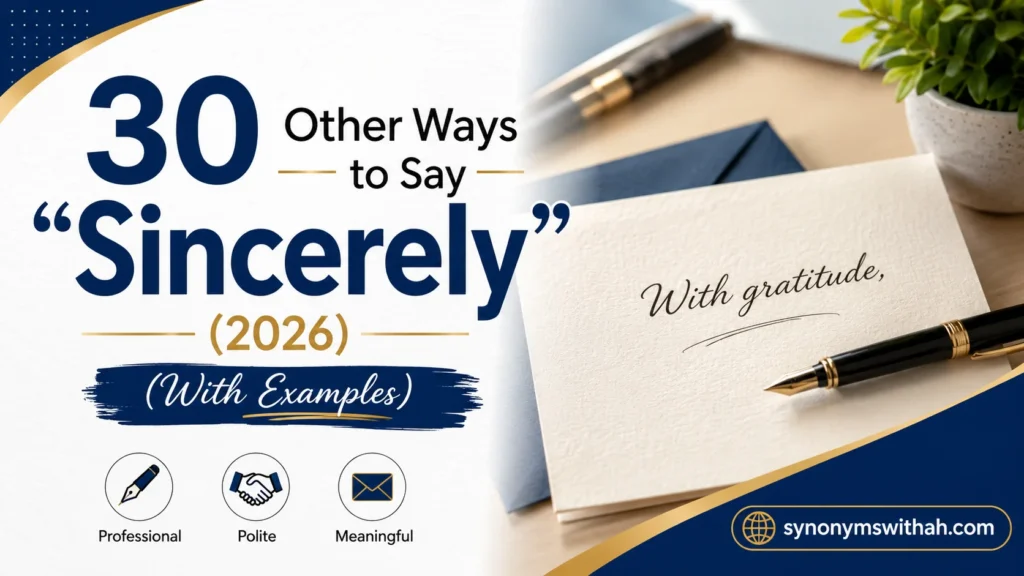

30 Other Ways to Say “Sincerely” (2026) (With Examples) helps you choose a closing that sounds warm, professional, and genuine every time.
Sincerely is a classic salutation and closing that expresses honest, true feelings, care, respect, courtesy, appreciation, and gratitude. Whether you write a letter, email, business email, friendly note, note, letters, or emails, the right closing phrase can transform the tone of your message and leave a lasting impression on readers. This 2026 guide helps you learn 30 and even 50 examples of sincere synonyms, synonyms, and every useful synonym with simple meanings, real usage, and practical guidance. From my own experience, making small shifts in phrasing and choosing creative alternatives makes writing feel more personal, warm, heartfelt, authentic, friendly, meaningful, and memorable.
Strong letter writing, email closing, and correspondence depend on more than one word. The right sign-off, sign-offs, signature, or Best Regards should match your style, voice, personality, choice, and relationship with a client, colleague, recruiter, teacher, or other people. A formal or informal ending can connect on a deeper level, convey professionalism, kindness, empathy, thoughtfulness, clarity, and help your communication, communication skills, and expression resonate naturally. Carefully picked phrases, subtle changes, and an engaging style also avoid repetition, making every ending feel unique, thoughtful, and real.
What Does “Sincerely” Mean?
The word “Sincerely” is a traditional closing used at the end of letters and emails to express honesty, respect, and genuine intentions. It tells the reader that your message is written with truthfulness, professionalism, and good faith. Because of its neutral and respectful nature, “Sincerely” is commonly used in business correspondence, academic writing, cover letters, formal requests, and other professional communications. Although it remains one of the safest ways to end a message, choosing a different sign-off can sometimes better reflect your relationship with the recipient or the tone you want to create.
READ ALSO: 30 Other Ways to Say “Thank You for Your Interest” (With Examples)
Is It Professional or Polite to Say “Sincerely”?
Yes, “Sincerely” is both professional and polite. It has been accepted as a standard email and letter closing for decades because it works well in nearly every formal situation. Whether you’re communicating with a hiring manager, customer, professor, client, or colleague, it conveys respect, courtesy, and professional etiquette. However, modern communication often benefits from a slightly more personal closing. Alternatives like Best regards, Kind regards, or Warm regards can make your message feel friendlier while still maintaining professionalism. Choosing the right ending depends on your audience, your relationship with the reader, and the purpose of your message.
Advantages and Disadvantages of Saying “Sincerely”
Advantages
- Professional and widely accepted.
- Shows respect and honesty.
- Suitable for formal letters and emails.
- Appropriate for job applications and business communication.
- Easy to understand across different cultures.
- Creates a polished and courteous ending.
Disadvantages
- Can sound generic.
- May feel too formal for friendly emails.
- Doesn’t express much personality.
- Less warm than modern email closings.
- Frequently overused in business writing.
- May not match casual workplace communication.
30 Alternatives to Say “Sincerely”
- Best regards
- Kind regards
- Warm regards
- Respectfully
- Yours truly
- Yours faithfully
- With appreciation
- Many thanks
- Thank you
- Best wishes
- Warm wishes
- All the best
- With gratitude
- Respectfully yours
- Cordially
- With kind regards
- Take care
- Have a wonderful day
- Looking forward to hearing from you
- With thanks
- Gratefully
- Cheers
- Stay well
- Wishing you the best
- Until next time
- Faithfully yours
- Yours respectfully
- With warmest regards
- Much appreciated
- Thank you again
1. Best Regards
Meaning
A professional and friendly closing that expresses goodwill toward the reader.
Definition
“Best regards” is a respectful sign-off commonly used in business emails and professional communication.
Detailed Explanation
This alternative offers a balance between formality and warmth. It sounds more modern than “Sincerely” while remaining suitable for clients, managers, coworkers, and business partners. It’s one of the safest closings for everyday workplace communication.
Scenario Example
Thank you for your time today. I look forward to working with you.
Best regards, Emma
Best Use
Business emails, networking messages, client communication, and professional follow-ups.
Tone
Professional, friendly, and respectful.
2. Kind Regards
Meaning
A polite closing that expresses kindness and respect.
Definition
“Kind regards” is a courteous email ending that combines professionalism with a warm, approachable tone.
Detailed Explanation
This phrase is slightly warmer than “Best regards.” It’s especially useful when you want to sound respectful without appearing overly formal. Many professionals use it when corresponding with clients, colleagues, or people they know reasonably well.
Scenario Example
Please let me know if you have any questions.
Kind regards, Daniel
Best Use
Professional emails, customer service, business introductions, and workplace conversations.
Tone
Warm, courteous, and professional.
3. Warm Regards
Meaning
A closing that communicates friendliness, care, and respect.
Definition
“Warm regards” is a professional sign-off that adds a more personal and heartfelt touch.
Detailed Explanation
Unlike “Sincerely,” this expression helps create a stronger emotional connection. It’s ideal when you already have an established relationship with the recipient but still want to remain professional.
Scenario Example
I appreciate your continued support and look forward to our next meeting.
Warm regards, Sophia
Best Use
Client relationships, colleagues, mentors, and long-term business contacts.
Tone
Warm, genuine, and professional.
4. Respectfully
Meaning
Shows high respect for the recipient.
Definition
“Respectfully” is a formal sign-off used to demonstrate courtesy and deference.
Detailed Explanation
This alternative works particularly well when writing to someone in a position of authority, such as a supervisor, professor, government official, or executive. It emphasizes professionalism and appreciation for the reader.
Scenario Example
Thank you for considering my request.
Respectfully, Michael
Best Use
Formal requests, official letters, academic communication, and government correspondence.
Tone
Highly respectful, formal, and courteous.
5. Yours Truly
Meaning
A classic way to express genuine sincerity.
Definition
“Yours truly” is a traditional letter closing that communicates honesty and goodwill.
Detailed Explanation
Although slightly old-fashioned, this phrase remains appropriate for formal letters and certain business communications. It carries nearly the same meaning as “Sincerely” but has a more traditional feel.
Scenario Example
Thank you for reviewing my application.
Yours truly, Olivia
Best Use
Cover letters, official correspondence, and formal business letters.
Tone
Formal, sincere, and respectful.
6. Yours Faithfully
Meaning
Expresses faithfulness and respect in formal writing.
Definition
“Yours faithfully” is traditionally used when the recipient’s name is unknown.
Detailed Explanation
In many countries, this closing follows greetings like “Dear Sir or Madam.” It remains a standard option in formal business letters and official communication.
Scenario Example
I appreciate your attention to this matter.
Yours faithfully, James Carter
Best Use
Formal letters addressed to an unknown recipient.
Tone
Formal, traditional, and respectful.
7. With Appreciation
Meaning
Expresses gratitude toward the recipient.
Definition
“With appreciation” is a thoughtful closing that highlights thankfulness.
Detailed Explanation
Use this phrase when someone has offered assistance, support, guidance, or valuable information. It leaves the reader feeling recognized and appreciated.
Scenario Example
Thank you for your valuable advice throughout this project.
With appreciation, Sarah
Best Use
Thank-you emails, appreciation letters, and mentor communication.
Tone
Grateful, warm, and sincere.
8. Many Thanks
Meaning
Shows strong appreciation.
Definition
“Many thanks” is a friendly and appreciative email closing.
Detailed Explanation
This sign-off works well after someone has completed a task, answered a question, or provided support. It sounds more conversational than “Sincerely.”
Scenario Example
I appreciate your quick response.
Many thanks, Alex
Best Use
Work emails, customer support, and everyday professional communication.
Tone
Friendly, appreciative, and polite.
9. Thank You
Meaning
Directly expresses gratitude.
Definition
“Thank you” can serve as both a closing and an expression of appreciation.
Detailed Explanation
Instead of ending with “Sincerely,” ending with “Thank you” reinforces your appreciation and encourages a positive response. It works particularly well when requesting assistance.
Scenario Example
I look forward to your reply.
Thank you, Jennifer
Best Use
Requests, customer service emails, and follow-up messages.
Tone
Grateful, polite, and respectful.
10. Best Wishes
Meaning
Offers good intentions and positive thoughts.
Definition
“Best wishes” is a warm closing that expresses goodwill toward the recipient.
Detailed Explanation
This alternative is suitable for both professional and personal communication. It feels more caring than “Sincerely” while remaining appropriate for many workplace situations.
Scenario Example
Congratulations on your new role. I know you’ll do great.
Best wishes, Rebecca
Best Use
Congratulations, farewell emails, friendly business communication, and personal messages.
Tone
Warm, encouraging, and positive.
11. Warm Wishes
Meaning
A caring closing that sends kind thoughts and good intentions to the reader.
Definition
“Warm wishes” is a friendly sign-off used to express genuine care while maintaining a polite tone.
Detailed Explanation
This phrase is more personal than “Sincerely” and works well when you have an established relationship with the recipient. It adds warmth without becoming overly casual, making it suitable for many professional and personal situations.
Scenario Example
I hope your upcoming project is a great success.
Warm wishes, Hannah
Best Use
Holiday messages, thank-you notes, supportive emails, and friendly professional communication.
Tone
Warm, thoughtful, and caring.
12. All the Best
Meaning
Expresses your hope that the recipient experiences success and happiness.
Definition
“All the best” is a versatile closing that wishes someone well in their future endeavors.
Detailed Explanation
This alternative sounds natural and friendly while remaining appropriate in many workplaces. It is commonly used when ending conversations on a positive note or encouraging someone before an important event.
Scenario Example
Good luck with your presentation next week.
All the best, Brian
Best Use
Farewell emails, career changes, project completion, and friendly business messages.
Tone
Positive, supportive, and friendly.
13. With Gratitude
Meaning
Shows deep appreciation for someone’s help or kindness.
Definition
“With gratitude” is a heartfelt closing that emphasizes sincere thankfulness.
Detailed Explanation
If someone has invested time, effort, or expertise to help you, this closing demonstrates meaningful appreciation. It feels more personal than simply writing “Thank you.”
Scenario Example
Your guidance made this project much easier.
With gratitude, Emily
Best Use
Thank-you letters, mentorship emails, volunteer appreciation, and recognition messages.
Tone
Heartfelt, grateful, and sincere.
14. Respectfully Yours
Meaning
Communicates respect, courtesy, and professionalism.
Definition
“Respectfully yours” is a formal sign-off often used in official correspondence.
Detailed Explanation
This phrase places greater emphasis on respect than “Sincerely.” It is especially appropriate when communicating with senior professionals, government officials, educators, or organizational leaders.
Scenario Example
Thank you for considering my proposal.
Respectfully yours, William
Best Use
Formal requests, legal correspondence, academic letters, and official communication.
Tone
Formal, respectful, and professional.
15. Cordially
Meaning
Expresses courtesy and goodwill.
Definition
“Cordially” is a polite closing that conveys friendliness while maintaining professionalism.
Detailed Explanation
Although it sounds slightly formal, “Cordially” remains an excellent alternative for business communication. It works well when you want to appear approachable and respectful.
Scenario Example
Thank you for meeting with me today.
Cordially, Nathan
Best Use
Business correspondence, invitations, client communication, and formal emails.
Tone
Professional, courteous, and pleasant.
16. With Kind Regards
Meaning
Expresses kindness, respect, and warm wishes.
Definition
“With kind regards” is an extended version of “Kind regards” that sounds slightly more thoughtful.
Detailed Explanation
This closing is ideal when writing to valued clients, coworkers, or professional contacts. It maintains a polished appearance while adding a touch of warmth.
Scenario Example
I appreciate your continued partnership.
With kind regards, Olivia
Best Use
Professional emails, customer relationships, networking, and client communication.
Tone
Warm, professional, and respectful.
17. Take Care
Meaning
Shows concern for the recipient’s well-being.
Definition
“Take care” is a caring and friendly closing often used with people you know.
Detailed Explanation
Unlike “Sincerely,” this phrase focuses on the person rather than the message. It creates a stronger personal connection and leaves the conversation on a compassionate note.
Scenario Example
I hope everything goes smoothly this week.
Take care, Jessica
Best Use
Coworkers, friends, clients you know well, and supportive emails.
Tone
Friendly, caring, and genuine.
18. Have a Wonderful Day
Meaning
Ends your message with a positive wish for the recipient.
Definition
“Have a wonderful day” is a cheerful email closing that encourages positivity.
Detailed Explanation
This alternative works well when your message is brief or conversational. It leaves readers with a pleasant impression and makes your communication feel approachable.
Scenario Example
Thank you for your quick assistance.
Have a wonderful day, Grace
Best Use
Customer service, workplace emails, scheduling messages, and casual professional communication.
Tone
Positive, cheerful, and friendly.
19. Looking Forward to Hearing from You
Meaning
Expresses anticipation for the recipient’s reply.
Definition
“Looking forward to hearing from you” is a closing that encourages continued communication.
Detailed Explanation
This phrase is particularly useful when your email includes a question, proposal, or request. It politely reminds the recipient that you’re expecting a response while maintaining a respectful tone.
Scenario Example
Please let me know your thoughts on the proposal.
Looking forward to hearing from you, Ethan
Best Use
Follow-up emails, proposals, interviews, and client communication.
Tone
Professional, optimistic, and courteous.
20. With Thanks
Meaning
Expresses appreciation before ending your message.
Definition
“With thanks” is a concise closing that communicates gratitude.
Detailed Explanation
This phrase is especially appropriate when someone has already provided help or when you’re thanking them in advance for their assistance. It sounds professional while remaining warm and appreciative.
Scenario Example
Thank you for reviewing the attached document.
With thanks, Chloe
Best Use
Business emails, requests, project collaboration, and appreciation messages.
Tone
Grateful, respectful, and professional.
21. Gratefully
Meaning
Expresses deep appreciation and heartfelt thanks.
Definition
“Gratefully” is a sincere closing used to show genuine thankfulness for someone’s time, help, or generosity.
Detailed Explanation
This alternative places the emphasis on your appreciation rather than simply ending the message. It is especially effective when someone has gone out of their way to assist you. Compared to “Sincerely,” it creates a stronger emotional connection while remaining appropriate for many professional situations.
Scenario Example
Thank you for your continued encouragement throughout this project.
Gratefully, Isabella
Best Use
Thank-you letters, mentorship emails, appreciation notes, and charitable communications.
Tone
Heartfelt, grateful, and sincere.
22. Cheers
Meaning
A casual way to express good wishes and appreciation.
Definition
“Cheers” is an informal closing commonly used in everyday professional and personal communication.
Detailed Explanation
This sign-off is popular in many English-speaking countries. While it may be too casual for formal letters or job applications, it works well with colleagues, teammates, and people you communicate with regularly.
Scenario Example
Thanks for sending the updated report.
Cheers, Liam
Best Use
Casual workplace emails, coworkers, team communication, and friendly conversations.
Tone
Casual, friendly, and approachable.
23. Stay Well
Meaning
Expresses concern for the recipient’s health and well-being.
Definition
“Stay well” is a thoughtful closing that wishes the reader continued good health.
Detailed Explanation
This phrase became especially common in professional communication when people wanted to show empathy and care. It remains an excellent choice whenever you want your message to feel warm and supportive.
Scenario Example
I hope everything goes well with your upcoming move.
Stay well, Sophia
Best Use
Supportive emails, personal messages, healthcare communication, and friendly business correspondence.
Tone
Caring, compassionate, and warm.
24. Wishing You the Best
Meaning
Expresses hope for the recipient’s future success and happiness.
Definition
“Wishing you the best” is a positive sign-off that sends encouragement and goodwill.
Detailed Explanation
This alternative is ideal when someone is starting a new job, moving to a different city, graduating, or taking on a new opportunity. It leaves your message on an encouraging and optimistic note.
Scenario Example
Congratulations on your new position.
Wishing you the best, Noah
Best Use
Congratulations, farewells, retirement messages, and career transitions.
Tone
Encouraging, supportive, and optimistic.
25. Until Next Time
Meaning
Shows that you expect to communicate again in the future.
Definition
“Until next time” is a friendly closing that suggests an ongoing relationship.
Detailed Explanation
Unlike “Sincerely,” this phrase emphasizes future conversations rather than ending the current one. It is especially suitable for recurring meetings, newsletters, coaching sessions, or ongoing partnerships.
Scenario Example
Thank you for another productive meeting.
Until next time, Charlotte
Best Use
Recurring clients, newsletters, coaching, consulting, and regular professional communication.
Tone
Friendly, conversational, and positive.
26. Faithfully Yours
Meaning
Shows loyalty, respect, and honesty.
Definition
“Faithfully yours” is a traditional sign-off commonly found in formal correspondence.
Detailed Explanation
This phrase is similar to “Yours faithfully” and remains appropriate for highly formal letters. It communicates professionalism and genuine respect for the recipient.
Scenario Example
I appreciate your consideration of my request.
Faithfully yours, Benjamin
Best Use
Official letters, government communication, and formal business correspondence.
Tone
Formal, respectful, and traditional.
27. Yours Respectfully
Meaning
Expresses sincere respect and courtesy.
Definition
“Yours respectfully” is a formal closing that places emphasis on honoring the recipient.
Detailed Explanation
This alternative works particularly well when addressing executives, professors, judges, military personnel, or government officials. It reflects humility and professionalism while maintaining a polished tone.
Scenario Example
Thank you for reviewing my submission.
Yours respectfully, Amelia
Best Use
Academic writing, legal correspondence, official requests, and formal communication.
Tone
Highly respectful, formal, and courteous.
28. With Warmest Regards
Meaning
Expresses deep goodwill and heartfelt kindness.
Definition
“With warmest regards” is a thoughtful closing that conveys appreciation and genuine affection.
Detailed Explanation
Compared to “Warm regards,” this version feels even more personal. It is suitable for long-term clients, trusted colleagues, mentors, and personal acquaintances while still sounding polished.
Scenario Example
Thank you for your friendship and continued support.
With warmest regards, Ella
Best Use
Holiday greetings, appreciation letters, long-term professional relationships, and personal correspondence.
Tone
Warm, heartfelt, and sincere.
29. Much Appreciated
Meaning
Shows that someone’s effort or assistance is greatly valued.
Definition
“Much appreciated” is a concise expression of sincere gratitude.
Detailed Explanation
This phrase is often used after receiving help, advice, or information. It keeps your closing brief while still making the recipient feel appreciated.
Scenario Example
Thank you for completing the revisions so quickly.
Much appreciated, Lucas
Best Use
Workplace emails, project collaboration, customer support, and professional follow-ups.
Tone
Appreciative, friendly, and respectful.
30. Thank You Again
Meaning
Reinforces your appreciation before ending the message.
Definition
“Thank you again” is a polite closing that emphasizes continued gratitude.
Detailed Explanation
This alternative works well when the purpose of your message is to acknowledge someone’s effort, support, or generosity. It feels warmer than “Sincerely” while remaining suitable for professional communication.
Scenario Example
I truly appreciate your guidance throughout this process.
Thank you again, Victoria
Best Use
Follow-up emails, appreciation messages, customer service, interviews, and thank-you letters.
Tone
Grateful, polite, and genuine.
FAQs
What does “Sincerely” mean in a letter or email?
Sincerely is a polite and professional closing that shows honesty, respect, and genuine feelings. It is commonly used in business emails, formal letters, and professional correspondence.
Is “Sincerely” still appropriate in 2026?
Yes. Sincerely remains a trusted and professional email closing in 2026. However, many people also use modern alternatives to better match the tone of their message and their relationship with the reader.
What are some professional alternatives to “Sincerely”?
Some popular options include Best Regards, Kind Regards, Respectfully, With Appreciation, Warm Regards, Yours Truly, Cordially, and Many Thanks. The best choice depends on your audience and purpose.
When should I avoid using “Sincerely”?
You may want to avoid sincerely in very casual conversations with close friends or family. In those situations, a warmer or more relaxed sign-off often feels more natural.
Which closing works best for a business email?
For a business email, Best Regards, Kind Regards, Respectfully, and Sincerely are all excellent choices. Pick one that matches the level of formality and your relationship with the recipient.
Can students use alternatives to “Sincerely”?
Absolutely. Students can use alternatives in emails to teachers, scholarship applications, internship requests, and college admissions letters. Choosing the right closing helps create a positive final impression.
Why is using different email closings important?
Using different closings prevents repetition and allows you to match the tone of each message. It also makes your writing sound more natural, thoughtful, and engaging.
How do I choose the best sign-off for my message?
Think about who will read your message and why you are writing. A formal email may need Sincerely or Respectfully, while a friendly email may sound better with Best Regards, Warm Regards, or another suitable alternative.
Conclusion
Finding the right ending can make every email, letter, or note feel more personal and memorable. While Sincerely is a timeless choice, exploring different sign-offs helps you match the tone, audience, and purpose of your message. The 30 Other Ways to Say “Sincerely” (2026) (With Examples) in this guide give you practical options for professional, formal, and friendly communication so you can leave a positive and lasting impression every time.