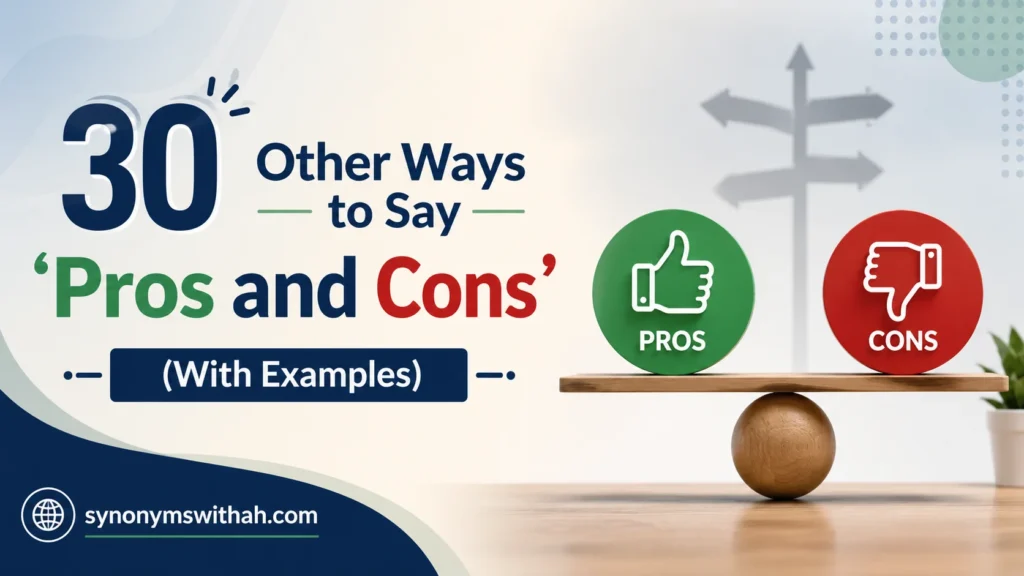

30 Other Ways to Say “Pros and Cons” (With Examples) helps you discover professional, formal, casual, academic, and creative alternatives with examples. This guide explains the meaning, pronunciation, and usage of each expression, making your writing more natural, polished, and human.
I’ve noticed that improving word choice, tone, and language can quickly replace a common phrase with a stronger one. Whether you are working on formal writing, academic writing, business writing, or persuasive writing, the right presentation language helps your message connect with every audience. Better communication, communication skills, and professional vocabulary also enhance content, messaging, and presentation, while building trust, understanding, and professionalism. When discussing decisions, proposal ideas, project risks, or strategic options, using balanced analysis, evaluation, comparison, and decision-making lets you present advantages, disadvantages, benefits, drawbacks, strengths, weaknesses, opportunities, and challenges with clarity, authority, and precision.
This approach works well for reports, emails, meetings, essays, IELTS tasks, students‘ work, social media posting, online discussions, and corporate or executive workplace communication, helping your credible message feel clear, concise, respectful, thoughtful, effective, engaging, refined, relatable, and well received instead of conversational, simplistic, or impersonal.
What Does “Pros and Cons” Mean?
“Pros and cons” refers to the advantages and disadvantages, benefits and drawbacks, or positive and negative aspects of something. People use this phrase when comparing options before making a decision.
It helps create a balanced view by considering what works well and what may create challenges. For example, when choosing a new job, someone may look at the salary, opportunities, and benefits as pros while considering the workload or distance as cons.
READ ALSO: 30 Other Ways to Say “Thank You Too” (With Examples)
Is It Professional/Polite to Say “Pros and Cons”?
Yes, saying “pros and cons” is professional and polite in many everyday and workplace situations. However, in formal writing, presentations, or business communication, alternatives like advantages and disadvantages or benefits and considerations may sound more polished.
Choosing the right phrase depends on your audience, tone, and purpose. A thoughtful alternative can make your message feel more respectful, organized, and professional.
Advantages of Using Alternatives to “Pros and Cons”
- More Professional Communication: Using phrases like “advantages and disadvantages” or “benefits and limitations” can make your writing sound more polished and suitable for formal situations.
- Better Clarity: Alternative phrases can explain ideas more specifically, helping readers understand whether you mean benefits, risks, challenges, or opportunities.
- Improved Expression: Different alternatives allow you to choose words that match the tone, audience, and purpose of your message.
- Balanced Thinking: These phrases encourage people to consider both positive and negative sides before making decisions.
- More Engaging Writing: Using varied language makes articles, reports, and conversations feel less repetitive and more thoughtful.
Disadvantages of Using Alternatives to “Pros and Cons”
- May Sound Too Formal: Some alternatives can feel overly professional or complicated in casual conversations.
- Possible Confusion: Certain phrases may not have the same simple meaning as “pros and cons,” which can confuse some readers.
- Requires More Thought: Choosing the right alternative takes extra effort compared to using the common phrase.
- Less Familiar to Some Audiences: People may immediately understand “pros and cons” but need more explanation for formal alternatives.
- Can Change the Meaning Slightly: Some alternatives focus on specific areas, such as risks or benefits, rather than covering all positive and negative points.
Synonyms For “Pros and Cons”
- Advantages and Disadvantages
- Benefits and Drawbacks
- Strengths and Weaknesses
- Positive and Negative Aspects
- Benefits and Limitations
- Opportunities and Challenges
- Favorable and Unfavorable Points
- Positive and Negative Factors
- Merits and Demerits
- Upsides and Downsides
- Gains and Losses
- Rewards and Risks
- Strengths and Challenges
- Positive Outcomes and Concerns
- Advantages and Challenges
- Value and Limitations
- Prospects and Problems
- Positive Features and Limitations
- Benefits and Concerns
- Strengths and Areas for Improvement
- Positive Elements and Challenges
- Benefits and Trade-Offs
- Gains and Challenges
- Opportunities and Risks
- Strengths and Limitations
- Positive Points and Negative Points
- Good Points and Challenges
- Advantages and Concerns
- Benefits and Possible Issues
- Positive Sides and Negative Sides
1. Advantages and Disadvantages
- Meaning: The positive and negative sides of something.
- Definition: A formal way to describe benefits and limitations.
- Detailed Explanation: This phrase is widely used in professional writing because it sounds balanced and objective.
- Scenario Example: “The report explains the advantages and disadvantages of remote work.”
- Best Use: Business reports, essays, and presentations.
- Tone: Formal and professional
2. Benefits and Drawbacks
- Meaning: The helpful parts and possible problems.
- Definition: A phrase showing both positive outcomes and challenges.
- Detailed Explanation: It focuses on what something offers and what concerns may exist.
- Scenario Example: “We discussed the benefits and drawbacks of the new policy.”
- Best Use: Workplace discussions and evaluations.
- Tone: Balanced and thoughtful
3. Strengths and Weaknesses
- Meaning: The strong and weaker points of something.
- Definition: A comparison of positive qualities and limitations.
- Detailed Explanation: Often used when analyzing people, plans, or ideas.
- Scenario Example: “The review highlights the strengths and weaknesses of the strategy.”
- Best Use: Reviews and assessments.
- Tone: Analytical
4. Positive and Negative Aspects
- Meaning: The good and bad elements.
- Definition: A neutral phrase for evaluating situations.
- Detailed Explanation: It creates a clear comparison without sounding harsh.
- Scenario Example: “Let’s explore the positive and negative aspects of this decision.”
- Best Use: Discussions and articles.
- Tone: Neutral
5. Benefits and Limitations
- Meaning: Helpful features and restrictions.
- Definition: A formal evaluation phrase.
- Detailed Explanation: Useful when discussing realistic expectations.
- Scenario Example: “The study explains the benefits and limitations of the method.”
- Best Use: Research and academic writing.
- Tone: Professional
6. Opportunities and Challenges
- Meaning: Possible advantages and difficulties.
- Definition: A growth-focused alternative.
- Detailed Explanation: This phrase sounds encouraging while acknowledging obstacles.
- Scenario Example: “The project brings many opportunities and challenges.”
- Best Use: Planning and teamwork.
- Tone: Positive
7. Favorable and Unfavorable Points
- Meaning: Helpful and unhelpful factors.
- Definition: A formal comparison method.
- Detailed Explanation: It avoids casual language and sounds objective.
- Scenario Example: “The committee reviewed favorable and unfavorable points.”
- Best Use: Formal discussions.
- Tone: Respectful
8. Positive and Negative Factors
- Meaning: Elements that help or hurt a result.
- Definition: Specific influences affecting an outcome.
- Detailed Explanation: Useful for decision-making.
- Scenario Example: “We considered all positive and negative factors.”
- Best Use: Analysis.
- Tone: Clear
9. Merits and Demerits
- Meaning: Advantages and disadvantages.
- Definition: A traditional formal expression.
- Detailed Explanation: Common in academic and legal contexts.
- Scenario Example: “The debate covered the merits and demerits.”
- Best Use: Formal writing.
- Tone: Scholarly
10. Upsides and Downsides
- Meaning: Good and bad parts.
- Definition: A conversational alternative.
- Detailed Explanation: Sounds friendly and natural.
- Scenario Example: “Let’s talk about the upsides and downsides.”
- Best Use: Casual conversations.
- Tone: Friendly
11. Gains and Losses
- Meaning: What is achieved and what is sacrificed.
- Definition: A phrase focused on results.
- Detailed Explanation: Often used for financial or strategic decisions.
- Scenario Example: “The company reviewed the gains and losses.”
- Best Use: Business.
- Tone: Practical
12. Rewards and Risks
- Meaning: Benefits and possible problems.
- Definition: A decision-focused phrase.
- Detailed Explanation: Highlights uncertainty and outcomes.
- Scenario Example: “We evaluated the rewards and risks.”
- Best Use: Planning.
- Tone: Careful
13. Strengths and Challenges
- Meaning: Positive qualities and difficulties.
- Definition: A constructive alternative.
- Detailed Explanation: Focuses on improvement.
- Scenario Example: “The team discussed strengths and challenges.”
- Best Use: Team reviews.
- Tone: Encouraging
14. Positive Outcomes and Concerns
- Meaning: Good results and worries.
- Definition: A thoughtful evaluation phrase.
- Detailed Explanation: Useful for sensitive discussions.
- Scenario Example: “We considered positive outcomes and concerns.”
- Best Use: Meetings.
- Tone: Considerate
15. Advantages and Challenges
- Meaning: Benefits and difficulties.
- Definition: A modern professional alternative.
- Detailed Explanation: Balances optimism with realism.
- Scenario Example: “The plan has advantages and challenges.”
- Best Use: Presentations.
- Tone: Balanced
16. Value and Limitations
- Meaning: Importance and restrictions.
- Definition: A formal evaluation phrase.
- Detailed Explanation: Helps explain realistic expectations.
- Scenario Example: “The article discusses its value and limitations.”
- Best Use: Academic content.
- Tone: Formal
17. Prospects and Problems
- Meaning: Future possibilities and issues.
- Definition: A planning-focused alternative.
- Detailed Explanation: Useful for future decisions.
- Scenario Example: “We examined prospects and problems.”
- Best Use: Strategy.
- Tone: Thoughtful
18. Positive Features and Limitations
- Meaning: Good qualities and restrictions.
- Definition: A detailed comparison phrase.
- Detailed Explanation: Useful for products and services.
- Scenario Example: “The review lists positive features and limitations.”
- Best Use: Reviews.
- Tone: Informative
19. Benefits and Concerns
- Meaning: Helpful points and worries.
- Definition: A polite evaluation phrase.
- Detailed Explanation: Works well when discussing sensitive topics.
- Scenario Example: “Parents discussed the benefits and concerns.”
- Best Use: Conversations.
- Tone: Caring
20. Strengths and Areas for Improvement
- Meaning: Good qualities and things to develop.
- Definition: A constructive alternative.
- Detailed Explanation: Avoids negative wording.
- Scenario Example: “The feedback covers strengths and areas for improvement.”
- Best Use: Reviews.
- Tone: Supportive
21. Positive Elements and Challenges
- Meaning: Good parts and obstacles.
- Definition: A balanced phrase.
- Detailed Explanation: Encourages realistic thinking.
- Scenario Example: “The plan has positive elements and challenges.”
- Best Use: Projects.
- Tone: Optimistic
22. Benefits and Trade-Offs
- Meaning: Advantages and sacrifices.
- Definition: A decision-making phrase.
- Detailed Explanation: Shows that choices involve compromise.
- Scenario Example: “Every decision has benefits and trade-offs.”
- Best Use: Strategy.
- Tone: Mature
23. Gains and Challenges
- Meaning: Achievements and difficulties.
- Definition: A growth-oriented phrase.
- Detailed Explanation: Highlights progress and obstacles.
- Scenario Example: “The journey included gains and challenges.”
- Best Use: Personal development.
- Tone: Motivational
24. Opportunities and Risks
- Meaning: Chances and possible problems.
- Definition: A business-focused phrase.
- Detailed Explanation: Helps evaluate decisions.
- Scenario Example: “Investors studied opportunities and risks.”
- Best Use: Business.
- Tone: Strategic
25. Strengths and Limitations
- Meaning: Advantages and boundaries.
- Definition: A formal comparison.
- Detailed Explanation: Common in research.
- Scenario Example: “The paper explains strengths and limitations.”
- Best Use: Academic writing.
- Tone: Objective
26. Positive Points and Negative Points
- Meaning: Good and bad details.
- Definition: A simple alternative.
- Detailed Explanation: Easy for general audiences.
- Scenario Example: “We listed positive points and negative points.”
- Best Use: Everyday communication.
- Tone: Simple
27. Good Points and Challenges
- Meaning: Benefits and difficulties.
- Definition: A conversational phrase.
- Detailed Explanation: Makes discussions feel approachable.
- Scenario Example: “Let’s discuss the good points and challenges.”
- Best Use: Informal meetings.
- Tone: Friendly
28. Advantages and Concerns
- Meaning: Benefits and worries.
- Definition: A respectful evaluation phrase.
- Detailed Explanation: Shows awareness of different views.
- Scenario Example: “The proposal has advantages and concerns.”
- Best Use: Professional conversations.
- Tone: Respectful
29. Benefits and Possible Issues
- Meaning: Helpful results and potential problems.
- Definition: A careful alternative.
- Detailed Explanation: Useful when uncertainty exists.
- Scenario Example: “We reviewed benefits and possible issues.”
- Best Use: Planning.
- Tone: Careful
30. Positive Sides and Negative Sides
- Meaning: The good and bad parts.
- Definition: A clear and simple alternative.
- Detailed Explanation: Easy to understand and widely applicable.
- Scenario Example: “The discussion covered positive sides and negative sides.”
- Best Use: General communication.
- Tone: Balanced
FAQS
1. What does “pros and cons” mean?
The phrase pros and cons refers to the advantages and disadvantages of a decision, idea, or situation. It helps people compare both the positive and negative sides before making informed choices.
2. What are some professional alternatives to “pros and cons”?
Some common professional alternatives include advantages and disadvantages, strengths and weaknesses, benefits and drawbacks, trade-offs, balanced perspective, and comparative analysis. These expressions work well in reports, presentations, and workplace communication.
3. When should I avoid using “pros and cons”?
You may want to avoid it in formal reports, academic papers, business proposals, or executive communication where a more polished or precise expression fits the context better.
4. Are these alternatives useful for students?
Yes. Students can use these alternatives in essays, assignments, IELTS writing tasks, presentations, and research projects to improve vocabulary and make their writing sound more natural and professional.
5. Which alternative is best for business writing?
For business writing, phrases like advantages and disadvantages, benefits and drawbacks, strategic considerations, or strengths and weaknesses are clear, professional, and widely accepted.
6. Can I use these expressions in everyday conversations?
Absolutely. While some alternatives are formal, many are suitable for casual conversations, emails, online discussions, and social media posts. Choose the one that matches your audience and tone.
7. How can better word choice improve my writing?
Using varied expressions keeps your writing engaging, avoids repetition, improves clarity, and shows a stronger command of English vocabulary. It also helps your message sound more polished and credible.
8. How do I choose the right alternative?
Think about your audience, purpose, and level of formality. Academic writing often needs formal language, while everyday conversations allow simpler and more relaxed expressions.
Conclusion
Finding better ways to say pros and cons helps you communicate with greater clarity and confidence. Whether you are writing an academic essay, preparing a business report, sending an email, or chatting online, selecting the right alternative can make your message sound more professional, natural, and engaging. As you build your vocabulary and understand the meaning and tone of each expression, you will be able to choose the most effective phrase for every situation and communicate your ideas with greater impact.